Online Politics in China
In my opinion, online politics has the following three prerequisites: Environment, Technology and Passion.
1. Environment: the Internet users
China has attracted a great deal of attention from all over the world, ever since the economic reforms started from 1972, especially from the end of the 20th century. With the development of its economy, more and more Chinese people are able to afford personal computers and access to the Internet.
In 1994, China opened its own 64K international net line, becoming a part of global Internet world. As of December of 2005, the total number of area names in China is 2.6 million and 1.1 million of them are using “CN.” “CN” has become the most popular area name in Asia. In 2000, there were 265,000 websites founded in China. The number has increased up to 700,000 as of 2008. The number of IP addresses that China owns is close to those of Japan and the U.S., becoming the third largest in the world.
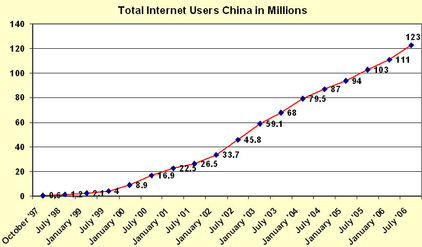
See above chart of the Internet usage in China by CNNIC (China Internet Network Information Center)

See above chart of estimated user in China by Pew.
"
China to overtake US in number of Internet users in 2009" by Jeremy Reimer
In 2000, there were 22,500,000 net citizens in China. The number rose to 1.1 billion in 2005. The Wall Street Journal published a report in 2003 stating “research made by the Chinese Academy of Social Sciences showed that the popularity of the Internet in China had been out of expectation. Even some rural and under-developed cities were using the Internet.” Studies showed that the Internet was more popular in big cities such as Beijing, Shanghai and Guangzhou. One third of China’s citizens used the Internet as their main approach to information and news every day.
2. Techonology: the development of online social networks
Online social networks are developing in China as well. There are many Chinese versions of famous online social networks, such as Facebook, Twitter and Youtube.
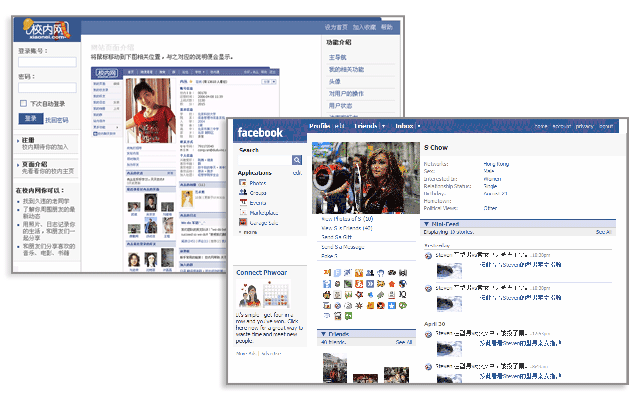
See above photo of the comparison of Facebook and
Xiaonei by Kelikuru.com. ("xiaonei.com v. facebook.com" May, 1st, 2008)

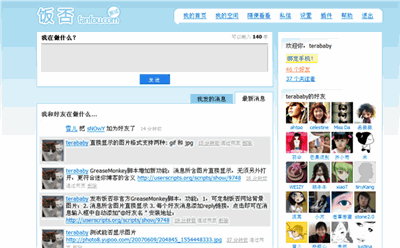 Comparision between "Twitter" and "fanfou."
3. Passion: the willingness to promote online politics
Using online social networks for politicians to recruit support is common in the U.S. (For example, President Obama has his own official Facebook page, twitter page, and official website, etc.) With the development of the Internet, the phenomenon of dealing with politics online has appeared in China as well.
Here are some examples of Chinese people standing up for their political views.
At the outset of the Olympics, many Chinese were disturbed by the harassment that occurred in the Olympics torch run in London, Paris and San Francisco. On one day, April 16, more than 2 million Chinese MSN messenger users added a pattern of “red heart” and the English word “China” in front of their online signatures to show their unity and patriotism to the world. Later on, the wave came to other online social networks such as Facebook. More than 40,000 Chinese users on Facebook voiced support of the Beijing Olympics -- and Facebook is not the primary social network in Mainland China.
 |
| In a day, more than 2 million Chinese people put a red heart in front of their MSN nicknames to show their support. |
Anti-CNN.com was established by Jin Rao, a 23-year-old Chinese student, in response to what the site claims are "the lies and distortions of facts from the Western media" concerning the 2008 Tibetan unrest and the People's Republic of China's national unity. The site proposes to “collect, classify, and exhibit the misbehaviors of Western media.”
According to the website, the word “anti-cnn” does not exclusively indicate its objection to CNN, but also to many other Western media sources, including the BBC, Der Spiegel, La Repubblica, n-tv, Bild, Fox News Channel and RTL. The website is “not founded against the western media, but against lies and fabricated stories in the media.” It’s “just another voice.”
Anti-CNN called attention to the fact that western media had frequently implied that it was the Chinese police, and not the rioters, who had killed people. Estimates of the casualty figures were positioned alongside phrases like 'Chinese crackdown,' giving the false impression that the Chinese authorities, not the rioters, were the source of the injuries and killings. According to Jin Rao, CNN and BBC only report selectively, and give a one-sided argument regarding the 2008 Tibetan unrest.

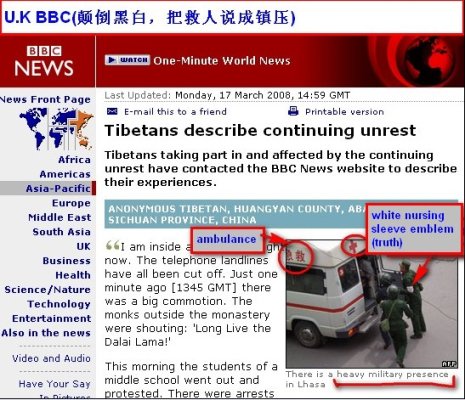
see above photo documenting erroneous reporting on the Tibet issue by the BBC (from anti-CNN).
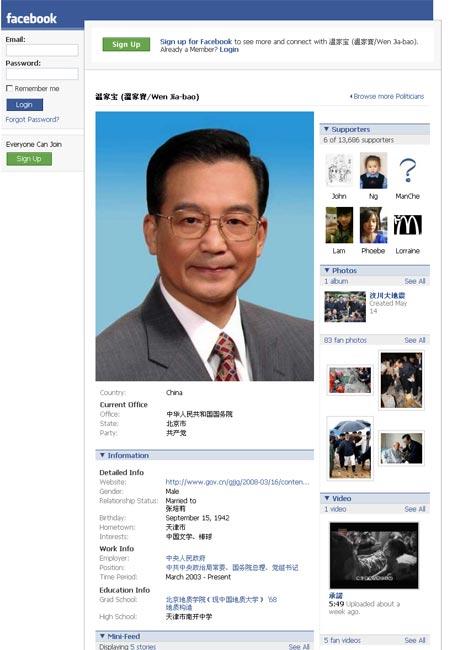
After the 5.12 Sichuan earthquake, the action of the Prime Minister of People’s Republic of China, who swiftly traveled to the danger zone, moved many people. This was probably not the official page of Wei Jiabao on Facebook, but he does have a Facebook page now. As of late 2008, there are 67,237 supporters, including both Chinese people and Westerners.
.
As we can see through above examples, Chinese people are eager to speak out. The easiest way for them to do so is through new media like the Internet, given its lack of boundaries. I believe that this expression through new media, from the bottom of the social structure, will be able to influence the authorities in the end and make the government more reliant on new media in its political dealings. Just give it time.
Go back to Web 2.0 home page.
Sources:
1.xiaonei.comXiaonei.com (校内网), which looks 90 percent similar to Facebook.com has become China's first and foremost popular social networking site among university students in China.
2. Fanfou.com
Fanfou.com is a personal mini blog in China. Basically, it is the Chinese version Twitter. It will be a great way to gain insight into China and Chinese thinking ahead of time, because people post instant messages about current news in China such as the Tibet issue, the Olympics issue and earthquake news.
3. Tudou.com Tudou.com is the largest video sharing platform in China, where users can upload, view and share video clips. Tudou went live on April 15, 2005 and by September 2007 it served over 55 million videos each day.
Gu, Naili
